

A gem just popped into my email. I immediately downloaded and read the article. Even the brief is amazingly authentic and validating. The Stewart Foundation in my opinion has been respectfully supporting the needed research in alted and has produced a gem. Enjoy.
From the email:
“If you would like to get emails like this subscribe to UCLA Center for the Transformation of Schools newsletter
Beyond One-Size-Fits-All Education Approaches:
Rethinking California’s Alternative
Education System
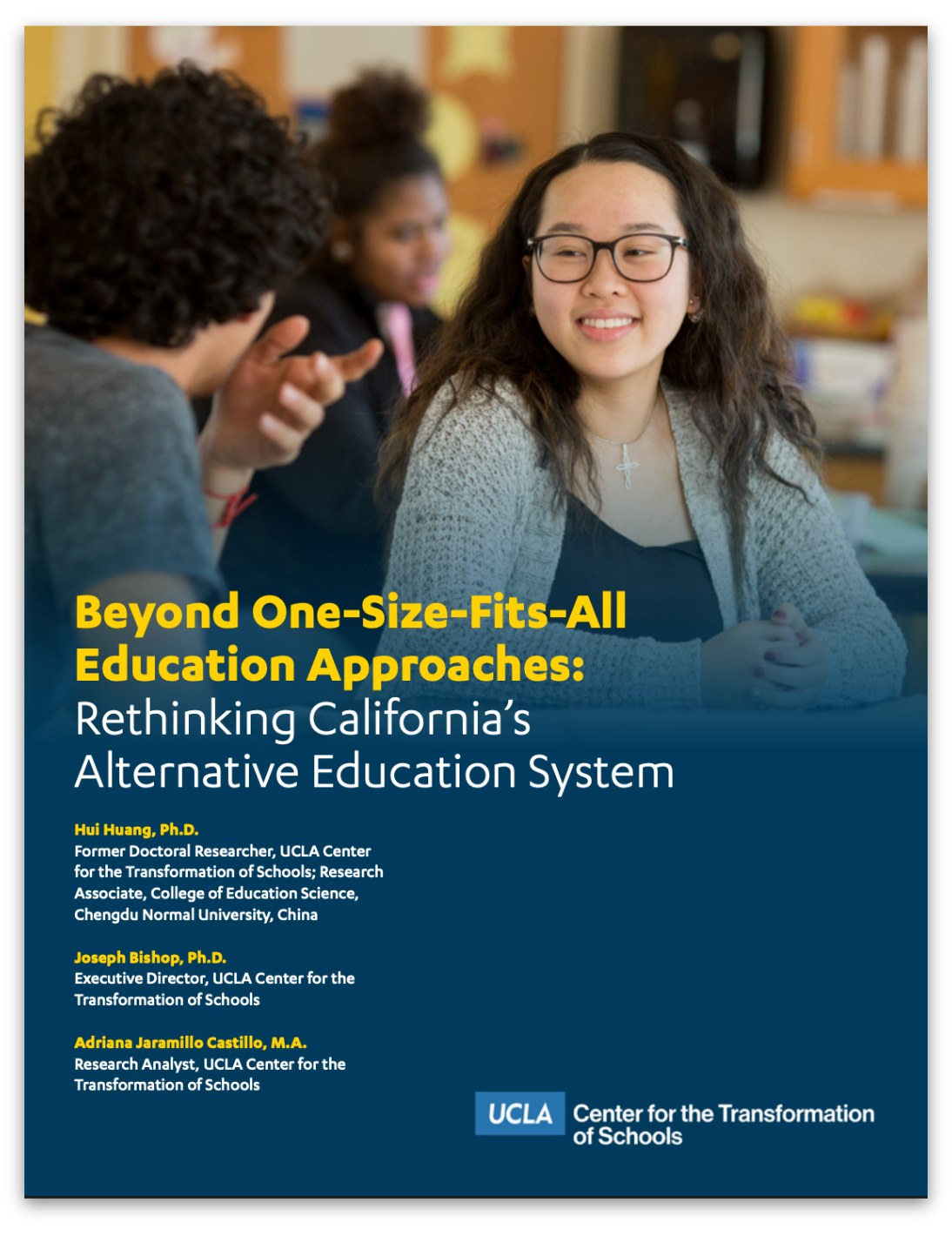
Hui Huang, Ph.D.
Joseph Bishop, Ph.D.
Adriana Jaramillo Castillo, M.A.
How can non-traditional schools better support students?
CTS examines California’s alternative education system, serving more than 150K students, and the critical role these schools play in providing flexible, supportive pathways to graduation. The report explores student demographics, school climate, and academic outcomes across alternative school types, highlighting how system-level barriers often push students off track to graduate. The findings illuminate the importance of strengthening the system to better support vulnerable student populations and their engagement, success, and long-term outcomes.
Non-Traditional School Types
Continuation School: Students are often credit-deficient or in need of a flexible schedule due to employment, family obligations, and/or other needs.
Community Day School: Serves expelled students, students referred by a School Attendance Review Board (SARB) or probation. High-risk youth are referred through a district-level process.
County Community School: Public schools operated by county offices of education to serve K-12 students who are expelled from their schools, referred by a SARB, requested by parent or guardian, referred by probation, on probation or parole, not in attendance in any school, and/or homeless.
Juvenile Court School: Provides an educational placement for students who are under the protection or authority of the juvenile court system, referred and incarcerated, and/or expelled students.
Opportunity School: Provides additional support for students who are unsuccessful academically. This can be due to irregular attendance, behavior challenges, and more.
Alternative School of Choice: Offers a different structure, learning philosophy, or academic emphasis to accommodate different student needs, interests, and learning styles.
Special Education School: Serves students with disabilities who require specialized instruction, supports, and services that cannot be fully provided in traditional school settings.
District Special Education Consortia: Collaborative partnerships among multiple school districts or local educational agencies (LEAs) that pool resources, funding, and specialized staff to provide comprehensive special education services.
Alternative Schools by Application: Mostly charter schools.
Student Characteristics
Latine students are overrepresented in alternative schools compared to traditional schools.
Alternative schools serve a significantly higher proportion of vulnerable student populations compared to traditional schools, including socioeconomically disadvantaged youth, students with disabilities, foster youth, students experiencing homelessness, and English Learners. This reflects the critical role alternative schools play in supporting students who experience significant educational instability and systemic barriers.
The proportions of these student populations vary substantially across different types of alternative schools, highlighting the diversity of missions among alternative schools and the need for differentiated policies, equitable resource allocations, and support systems.
Educational and School Climate Patterns in California’s Alternative Schools
Students attending alternative schools face significant challenges related to learning engagement, school conditions and climate, and academic performance, often experiencing greater barriers compared to their peers in non-alternative school settings. Suspensions, absenteeism, and dropout rates are higher while stability, graduation rates, and ELA/Math performance are lower compared to traditional schools.
The nature and extent of the educational challenges listed above vary across different types of alternative schools, emphasizing the need for context-specific policies and support systems that align with each school’s distinct mission and student population.
Students from historically marginalized communities—including highly mobile youth, racial minority students, English Learners, socioeconomically disadvantaged students, and students with disabilities—experience systemic barriers that significantly impact their educational outcomes in alternative schools.

Recommendations
Develop a Local Control Funding Formula (LCFF) category for alternative schools.
Build and sustain a specialized educator workforce for alternative schools.
Prioritize school stability and reduce student mobility with targeted Technical Assistance for alternative education schools as part of the Statewide System of Support.
Establish meaningful measures and accountability systems unique to alternative education schools.
Expand access to high-quality, differentiated instruction that matches school type, grade level, student, and staffing needs.

Thank you to the Stuart Foundation for supporting this work.”
It’s me again. I just want to say YES to all these recommendations. Let’s use our collective activism and voice to make these changes.
Somethings to note:
If you are not familiar with Opportunity Schools, the ed code is great. They were phases out and you can no longer start one in CA. However, if your district was grandfathered in with one, but can really support vulnerable students.
I really appreciate the definitions of all the schools including the differentiation between county community day schools and community day schools, which is different than community schools 🤪.
A quote from the article “Ultimately, this report calls for a shift from deficit-based narratives toward equitable, asset-based support systems that prioritize the success and holistic development of California’s most vulnerable youth.” I mean 🫶🙌🏼👍🏼
This beauty deserves a read and please send it to everyone you know who loves alted.
All the best,
-jamie